08 April 2024

The spirit of the night

02 December 2023 - Murara Pitta Camp; Day 7

Our group were still euphoric when we met for coffee at 4:30 in the dark and we stayed a little later at the camp to try and get the Orange-winged Pytilia that are sometimes seen around sunrise. The other group departed earlier with Siraj for the hour drive back to the valley for the last try for the Pitta and we wished them all the best, but the pressure/anxiety was palpable. 

Shortly after they departed, a pair of Pytilia put in a brief appearance and came in to the bird bath for a quick drink before disappearing - it was still gloomy, so the light was a little flat, but we were all more than happy

Orange-winged Pytilia (Pytilia afra)


Shortly after, a Grey-backed Camaroptera put in an appearance

Grey-backed Camaroptera (Camaroptera brevicaudata)


For the morning drive, we were with Derek and Thalane - we stopped again at the Lala Palm outside camp and got better images (especially with the camera on the right settings) of the Collared Palm Thrush

Collared Palm Thrush (Cichladusa arquata)


Next stop was a low level bridge where we tried again for Thick-billed Cuckoo - no luck with this Cuckoo, but plenty of other good birds whilst we waited, including African Golden Oriole

African Golden Oriole (Oriolus auratus)


African Goshawk

African Goshawk (Accipiter tachiro)


a fly over African Cuckoo

African Cuckoo (Cuculus gularis)


A few White-fronted Bee-eaters

White-fronted Bee-eater (Merops bullockoides)


and a single Böhm's Spinetail, at last in half decent light

Böhm's Spinetail (Neafrapus boehmi)


We then headed to another site on the river for Red-throated Twinspot, but had no luck. A bonus was stunning views of African Cuckoo-Hawk that passed by close overhead. Lots of birds with 'African' in their names this morning.....

African Cuckoo-Hawk (Aviceda cuculoides)


We then crossed the dry river bed to try another spot and this time had some luck with the Twinspot's, although they were far from obliging staying hidden in a dense thicket

Red-throated Twinspot (Hypargos niveoguttatus)


At the same spot, we had a Livingstone's Flycatcher - a real charismatic little species

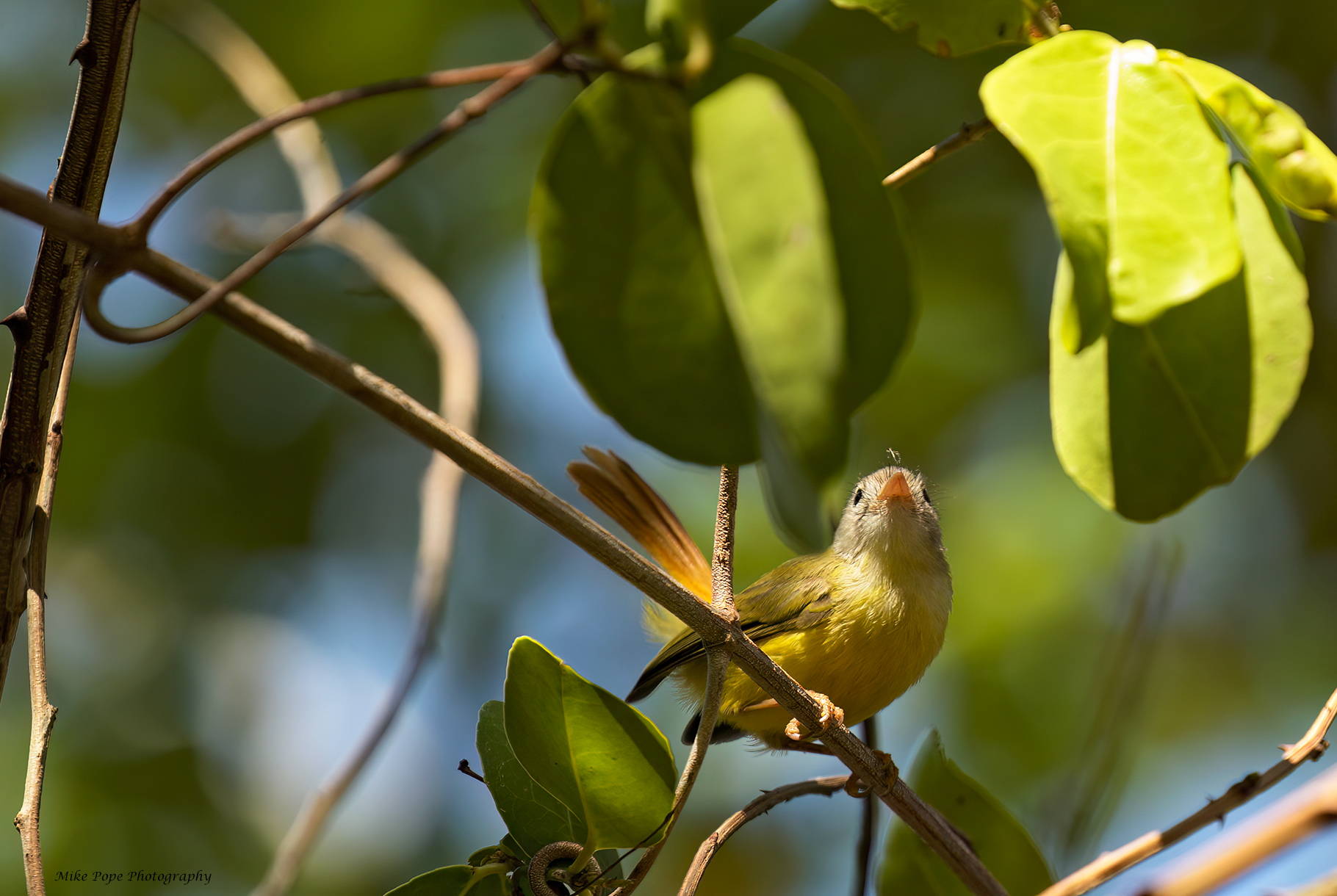
Livingstone's Flycatcher (Erythrocercus livingstonei)


and Southern Carmine Bee-eater

Southern Carmine Bee-eater (Merops nubicoides)


We tried again for the Snake Eagle and Dickinson's Kestrel on the drive back to camp without success, but did have a lone Shikra. 

Shikra (Accipiter badius)


Once back at camp, we could now really celebrate as a group as Siraj had found a Pitta for Richard, Shirley, Billy and Gayleen - so that was really fantastic news. Most had a siesta at lunchtime, but I did some birding around the camp, finding a much more obliging pair of Livingstone's

Livingstone's Flycatcher (Erythrocercus livingstonei)


As well as a juvenile Eurasian Golden Oriole

Eurasian Golden Oriole (Oriolus oriolus)


Red-billed Firefinch at the bird bath

Red-billed Firefinch (Lagonosticta senegala)


and these African Migrant's enjoying some moisture in the parking area, spot the Yellow Pansy imposter

African Migrant (Catopsilia florella)

African Yellow Pansy (Junonia h. cebrene)


Richard, Glynn and I had an afternoon drive with Derek finding a single Grey-headed Parrot, the only one for the trip 

Grey-headed Parrot (Poicephalus fuscicollis)


and later a Chestnut-backed Finch Lark in Mosoka Village

Male Chestnut-backed Sparrow-Lark (Eremopterix leucotis)


Another drive down the dry river bed looking for the Snake Eagle, but finding only a small herd of Ele's which was also great to see

African Elephant (Loxodonta africana)


We headed back to the small waterhole to wait for sunset. There were a few Green Pigeons in a big fruiting tree, but pretty well camouflaged 

African Green Pigeon (Treron calvus)


Along with Trumpeter Hornbill

Trumpeter Hornbill (Bycanistes bucinator)


We picked up a single White-headed Vulture drifting by overhead

White-headed Vulture (Trigonoceps occipitalis)


We setup our chairs on the perimeter of the waterhole before sunset enjoying the birds coming down to drink; Purple Indigobird - both male and female. I was trying to turn the female into a Zambezi - but I think I have the ID right as Purple.

Female Purple Indigobird (Vidua purpurascens)


Male Purple Indigobird (Vidua purpurascens)


Female Long-tailed Whydah, more straight forward to ID

Female Long-tailed Paradise Whydah (Vidua paradisaea) 


Red-billed Firefinch

Red-billed Firefinch (Lagonosticta senegala)


Woodland Kingfisher

Woodland Kingfisher (Halcyon senegalensis)


and of course the masses of Quelea's were still present

Red-billed Quelea (Quelea quelea)


As the sun was setting, the G+T's came out and we agreed on our new plan (2 spotlights, but still at 12800 ISO) to see and photograph another magical and mystical species that appears like a ghost out of the darkness and glides and flies silently around us while also drinking from the pool on the wing. 

This is probably one of the most challenging photographic challenges and experiences that you could wish for. We scratch our heads on how we can get better results in these conditions (probably fill flash) but are still thrilled with the results we do get of another iconic species. Meet the stunning Pennant-winged Nightjar....no excuses for the barrage of images

Male Pennant-winged Nightjar (Caprimulgus vexillarius)


Female Pennant-winged Nightjar (Caprimulgus vexillarius) drinking on the wing


There were a few Square-tailed Nightjar's in the mix

Square-tailed Nightjar (Caprimulgus fossii)


And a few Bats - not sure of the species

Bat sp.


This really was a truly special experience to end off our fantastic and rewarding stay at the Murara Pitta Camp that gave us many epic species and so many memories. On the drive back to camp, a Hare on the airstrip

Hare sp.


and then into camp for our final night over dinner, although our celebration was a little subdued, as adrenaline had now been replaced by fatigue.


05 April 2024

Pitta patter in the leaf litter

01 December 2023 - Murara Pitta Camp; Day 6

I don't think any of us needed the alarm to wake up in the dark this morning, but we certainly all had a sense of anticipation, trepidation and excitement when we gathered for coffee. At 5:30, Mike K, Rory, Glynn and I joined Siraj and Adam on their Cruiser to head down into the valley. 

Just outside the camp gate, we stopped for a pair of Collared Palm Thrush in the only Lala Palm around - my camera was still on last night's Nightjar settings - rookie mistake, but I then made sure it was correctly set for anything else we may encounter on route down into the valley

Collared Palm Thrush (Cichladusa arquata)


On the hour drive, I contemplated about the mystique that surrounds this elusive and enigmatic species. The African Pitta is an afrotropical species and an intra African migrant between Equatorial Africa and South-eastern Africa. 

The African Pitta was first described by French Ornithologist Louis Pierre Veillot in 1816 and given the name Pitta Angolensis, hence the original name of Angola Pitta. There are 3 sub-species and it is Pitta a. longipennis that occurs in Zimbabwe and Mozambique as a wet season breeder during a small window in the summer. This sub-species spends the austral winter in western Uganda and coastal Kenya and arrives in Southern Africa from late October and departs again in February.

It has a fast and direct flight and forages singly in leaf litter where it moves around in quick hops. Despite its extraordinary vibrant plumage and iridescent blue spots on the wing coverts, they can be extremely cryptic, secretive and frustrating to see, even once you have heard its distinctive call, as they are masters at keeping something between themselves and their observers.

The lower Zambezi Valley is a vast wild wilderness and once you are under the canopy of the Riparian Forest on the river bank, you could find yourself sharing a Pitta thicket with Lion, Leopard, Ele or Buffalo, so your senses are certainly highlighted whilst walking in the bush with your armed guide.

There is a short window of opportunity, before the rains start, to see this holy grail of birds. This is one of those few species that captivates all birders when they first see them after paging through their field guides. For us, we only had 2-days, so that already creates a lot of pressure, considering that it was still so dry as not much rain had fallen yet. I was brought back out of my dream state when we stopped at the first site. 

We exited the Cruiser and now the excitement and tension was palpable - walking quietly, slowly and in single file toward the site, we heard some Ele's nearby, so tension increased another notch. We got to the site/thicket, found a safe place to sit and waited and listened. After 45-minutes, not a peep, other than a Crowned Hornbill giving us the beady eye. Anxiety starts to niggle as we get back on the Cruiser and drive a little further to the 2nd site. 

Crowned Hornbill (Lophoceros alboterminatus)


Same routine, hearts pounding and single file through the bush under the canopy until we find the requisite 'Pitta' thicket. We find our places and sit quietly, this time we have partial success and hear two birds calling and our expectations rise slightly, but after an hour and all our bums have pins and needles, we have to admit defeat, these birds are not going to show themselves.

Now, with only one site left to check, pressure on the guides and nervousness and trepidation from us 4 birders. Another short drive and single file to the known site. Again, we find our places and sit back down on our numb bum's, quiet as church mice, although our pulses feel like they are pounding like drums. We hear the distinctive, but distant call. A little bit of playback, with our hearts in our mouth and suddenly a flash of blue, as a bird flies across the clearing, landing behind a dense thicket - it's here we all whisper, pulses going up another notch. Will it reveal itself, at least a little? 

It does finally, but so much vegetation between it and us

First glimpse of our African Pitta (Pitta angolensis)


We wait anxiously with baited breasts, sorry breathes and see a subtle movement and we all get another partial glimpse. No sudden movements as all cameras are slowly raised and ready - focusing acquisition is really tough, as true to form there is a lot of foliage between this magnificent Pitta and us. 

I set my focus point to the finest setting, to ensure I can focus between the smallest gap and manage to get this image as it hops into a small clearing


Siraj whispers to us that the Pitta will circle us and over the next hour, we all get glimpses through the vegetation of this iconic, bucket list bird.


It makes another pass around us and for a brief moment sits in the open through a small gap and I get my money shot for this encounter. I love how those iridescent blue spots on the wing coverts just glow in the gloom of the under story


Finally, it tires of us and exits stage right by flying up and perching briefly on a branch above us and bids us adios - Aagh, I have a small branch obstructing what would have been a clear image, but so satisfying nevertheless


After it departs, there was a collective sigh from all of us - I think we had all been holding our breath, but an experience that will be forever etched in our minds and memories. There is a reason the Pitta is iconic, considering the short window of opportunity, the adventure of getting to the wild wilderness where it is found and still with no guarantees of actually seeing it. A lot of factors have to align, but they did for us this morning with the effort of our two excellent guides - High fives all round and the numbness in our bums now long forgotten. 

But, the birding wasnt over yet - walking, no skipping, back to the Cruiser we heard African Broadbill and after some time, managed to track it down and enjoy its display flight while calling. We had it in dry foliage

African Broadbill (Smithornis capensis)


and then above us in the green canopy. There was not enough light to capture the display flight, but with video it would have been possible


Whilst at the Pitta site, we did also have Livingstone's Flycatcher and Red-throated Twinspot. We walked the dry river bed on the way back to the Cruiser, having distant views of Lilian's Lovebird

Lilian's Lovebird (Agapornis lilianae)


It was in the river bed, that 4 grown men really celebrated our Pitta sighting with our rendition of a 'Pitta' display dance..

From L to R - Glynn, Rory, Mike K and I - grown men celebrating


This was certainly one of the best birding mornings ever, for all of us! Elated we headed back to camp to discover that Richard, Shirley, Billy and Gayleen had no luck at all, so it was mixed emotions for the group and it felt wrong for us to celebrate when they had dipped - but there is still tomorrow and a little bit more added pressure on the guides. We had a hearty brunch and whilst working I kept an eye on the nearby bird bath and photographed a few birds in between mails and meetings - Ashy Flycatcher

Ashy Flycatcher (Muscicapa caerulescens)


Cinnamon-breasted Bunting

Cinnamon-breasted Bunting (Emberiza tahapisi)


Golden-breasted Bunting

Golden-breasted Bunting (Emberiza flaviventris)


Emerald-spotted Wood Dove

Emerald-spotted Wood Dove (Turtur chalcospilos)


Scarlet-chested Sunbird sipping some water

Female Scarlet-chested Sunbird (Chalcomitra senegalensis)


Yellow-bellied Greenbul

Yellow-bellied Greenbul (Chlorocichla flaviventris)


And this hectic Wasp

Wasp sp.


Late afternoon, we departed on our sundown drive sans Glynn who was going to photograph camp birds. This time Mike K, Rory and I were with Derek, as the other group commandeered Siraj and Adam. We stopped on a ridge outside camp for calling Shelley's Francolin - they were distant and obscured by grass, but we all got fair views

Shelley's Francolin (Scleroptila shelleyi)


Near the village, a Long-tailed Paradise Whydah in transitional plumage - not the Broad-tailed we were all hoping for which were still in winter plumage.

Long-tailed Paradise Whydah (Vidua paradisaea)


Derek pointed out this cool Orchard during the drive

Orchard sp.


We stopped at a crossing to the dry river bed and found Red-backed Shrike

Red-backed Shrike (Lanius collurio)


We then had a long drive through the dry river bed trying to find Western-banded Snake-Eagle, without success - but we did hear one calling, so that was quite frustrating. But, we did have many Southern Carmine Bee-eaters foraging in the river bed

Southern Carmine Bee-eater (Merops nubicoides)


The sun was starting to dip, so we started heading toward a large Baobab, stopping for a pair of Amur's

Amur Falcon (Falco amurensis)


At the Baobab, we waited until the sun had set and that is when the Mottled Spinetail's started dropping lower in the sky as they prepared to come in and roost for the night in the Baobab. Tough conditions in fading light against a grey sky

Mottled Spinetail (Telacanthura ussheri)


We then proceeded to our sundowner spot on a high bank over the dry riverbed and really enjoyed a few cold ones after what had been an incredible days birding..but it was not over just yet...

We started our drive back to camp in the dark and with the spotlights found our last target for the day - a pair of Three-banded Courser's that were tolerant of us getting out of the Cruiser and laying flat to get these cracking images

Three-banded Courser (Rhinoptilus cinctus)


What a day!


Glen Austin Pan delivers

21 June 2025 - Glen Austin Pan I'm still in the first month of my Big Bird Challenge, so enthusiasm is still high. I had a quick visit t...